What is LASIK eye surgery?
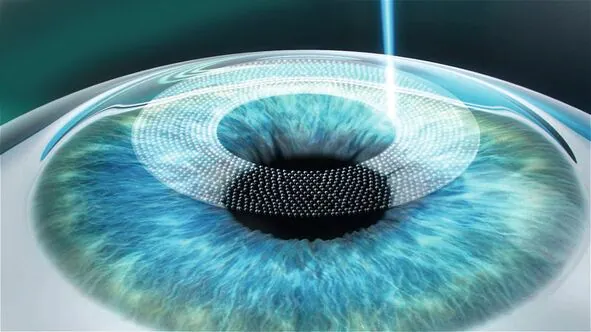
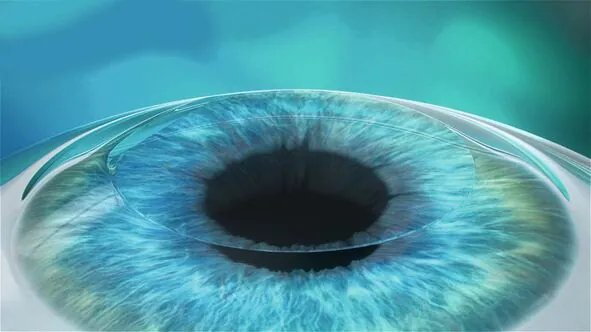
LASIK (Laser-assisted in Situ Keratomileusis) was developed at the end of the 1980s and has been widely performed since the late 1990s. Previously, the eye surgeon used a microkeratome (a thin, razor-sharp blade) to cut the flap. Today the practice uses a femtosecond laser (Zeiss VisuMax) to create the flap — hence the name Femto-LASIK. This laser-based approach is significantly more accurate and offers a higher margin of safety.
Course of the Femto-LASIK procedure
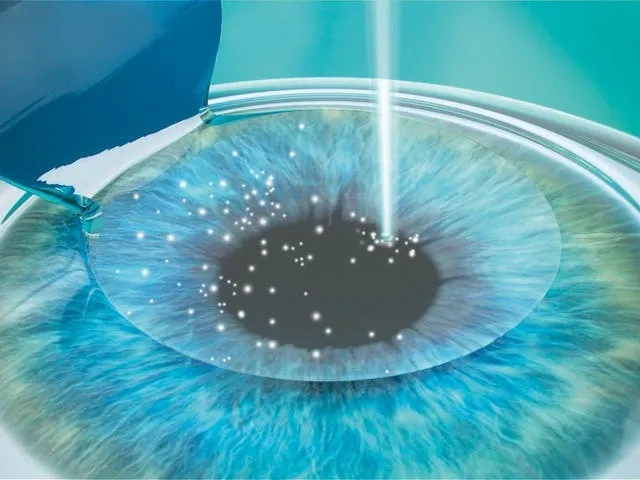
At the laser centre the wavescan measurements are repeated. You then receive a mild sedative and anaesthetic drops. The procedure has two phases: first the femtosecond laser for the flap, then the excimer laser for the correction:
- A small ring stabilises the eye under the Zeiss VisuMax femtosecond laser. Creating the flap takes just 7 seconds. The same is repeated on the other eye.
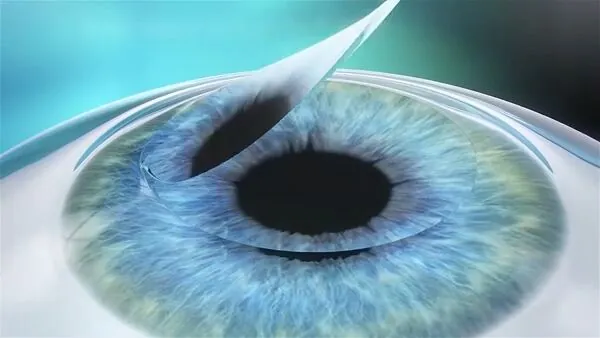
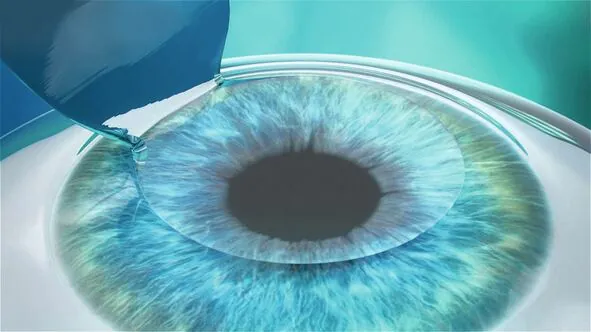
- You are moved under the excimer laser. The flap is gently loosened. Your vision becomes briefly blurry.
- You fixate on a blinking light. Iris and pupil are registered for the personalised, wavefront-guided treatment.
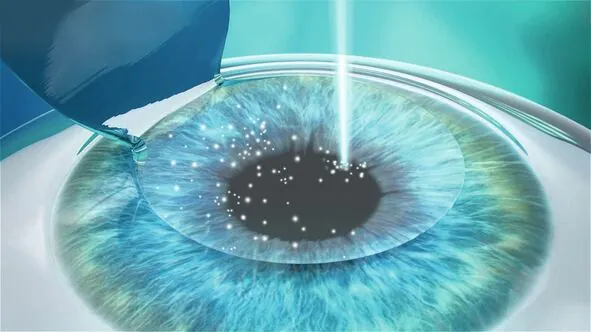
- The excimer laser reshapes the cornea in 10 to 40 seconds per eye. If you look away, the laser automatically pauses.
- The flap is repositioned and rinsed; it re-adheres on its own — no sutures needed.
- After a final check you receive a protective shield for the first nights.
Recovery after LASIK
Recovery is very fast. In the hours after the treatment vision is a little blurry and an irritated feeling may occur. The next day vision is already sharp and most daily activities can be resumed. A first check-up is scheduled 1 day after the treatment.
Screen work is usually possible from day 2 or 3. Contact and water sports are avoided for 4 weeks. Vision fully stabilises within 1 to 3 months. See the full drop schedule and recovery plan.
Possible complications
Femto-LASIK has been performed safely for more than ten years: over 1 million treatments per year worldwide. Nonetheless, as with any procedure, complications are possible:
- Over- or undercorrections: usually well treatable with a laser retreatment (included in the price within 24 months).
- Flap issues: very rare thanks to the femtosecond laser; in exceptional cases the flap can shift due to rubbing.
- Halos and glare: usually temporary (within 3 months). Strongly reduced thanks to wavefront-guided laser.
- Dryness complaints: common in the first 3–6 months, manageable with artificial tears.
- Corneal ectasia: extremely rare thanks to upfront Pentacam screening.
Eligibility for Femto-LASIK
Femto-LASIK is suitable for short-sightedness between −8 and +3 D and astigmatism up to 4 D. Conditions include a sufficiently thick cornea with normal topography, a stable correction and an age between 20 and 50 years. See all laser eye surgery eligibility criteria.