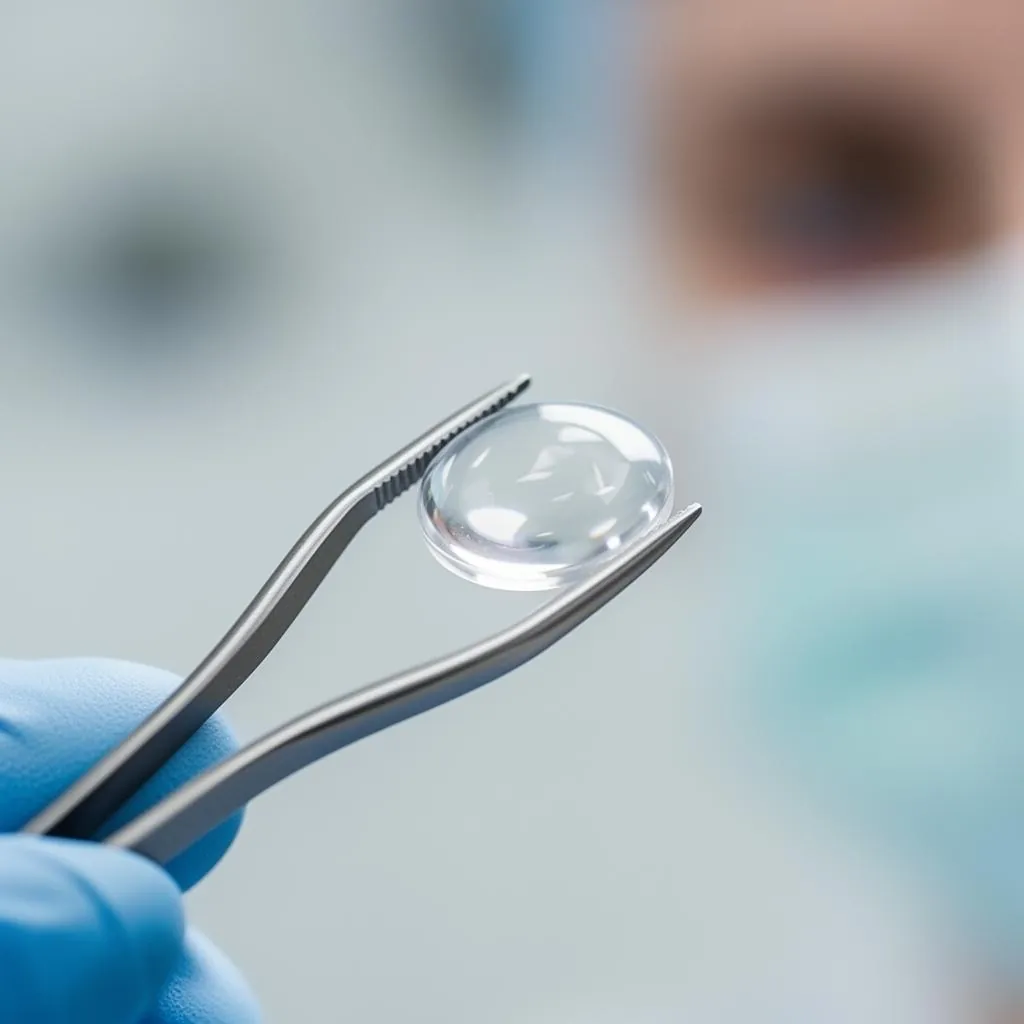
During a cataract operation or refractive lens exchange we replace the natural crystalline lens with an artificial lens. The choice of that intraocular lens (IOL) largely determines the visual end result and your spectacle independence.
The three IOL families
Each IOL type has its own range of sharpness. Below you see what each lens lets you see without glasses and what the pros and cons are.
Standard · NO SURCHARGE
Mono/unifocal IOL
Focus
1 focal point — usually distance
Near
Intermediate
Distance
Standard monofocal IOLs have a single focal point. We usually choose sharp distance vision. For near and intermediate distance (computer, cooking, household chores…) reading glasses will definitely be needed. The reverse is also possible: keep near vision without glasses, but distance glasses will then be required.
Largely reimbursed
Predictable result
No light disturbance
Considerations
Reading and/or distance glasses needed
No intermediate vision without glasses
Extended Depth of Focus
Comfort / EDOF
Focus
Distance + intermediate (60-80 cm)
Near
Intermediate
Distance
EDOF IOLs extend the range of sharpness. Their focus spans distance and intermediate (dashboard, computer, cooking, household chores) often without glasses. Excellent trade-off: many benefits with few side effects. Halos or starbursts around lights at night are rare.
These IOLs have three focal points. Incoming light is split between distance, intermediate and near. You can perform 80-85% of daily activities without glasses. Rarely, glasses are still needed (e.g. for long computer work, night driving or very small print).
80-85% glasses-free
Reading without glasses
Full focal spectrum
Considerations
Adaptation period (weeks-months)
Halos around lights at night
Personal surcharge
Toric version — for astigmatism
Do you have astigmatism (corneal distortion)? A toric version is available of each IOL type: monofocal, EDOF or trifocal. The IOL corrects astigmatism at the same time, so this spectacle correction also disappears.
Adaptation period with multifocal IOLs
With multifocal IOLs an adaptation period is sometimes needed to let the brain get used to the new vision. During the first months you may notice certain phenomena:
Halos around lights, but gradually fade.
A mild haze over distant objects.
Quicker fatigue with prolonged reading. This will diminish with sufficient light and the optimal reading distance (30-40 cm).
A multifocal IOL is not suitable for everyone. During the pre-operative work-up possible contra-indications are meticulously excluded and discussed with you by the ophthalmologist.
Who is a candidate for a premium IOL?
The ideal candidate is a patient with no other eye disease: no advanced glaucoma, no severe macular degeneration, a healthy cornea and good pupil function. An extensive pre-operative work-up is essential:
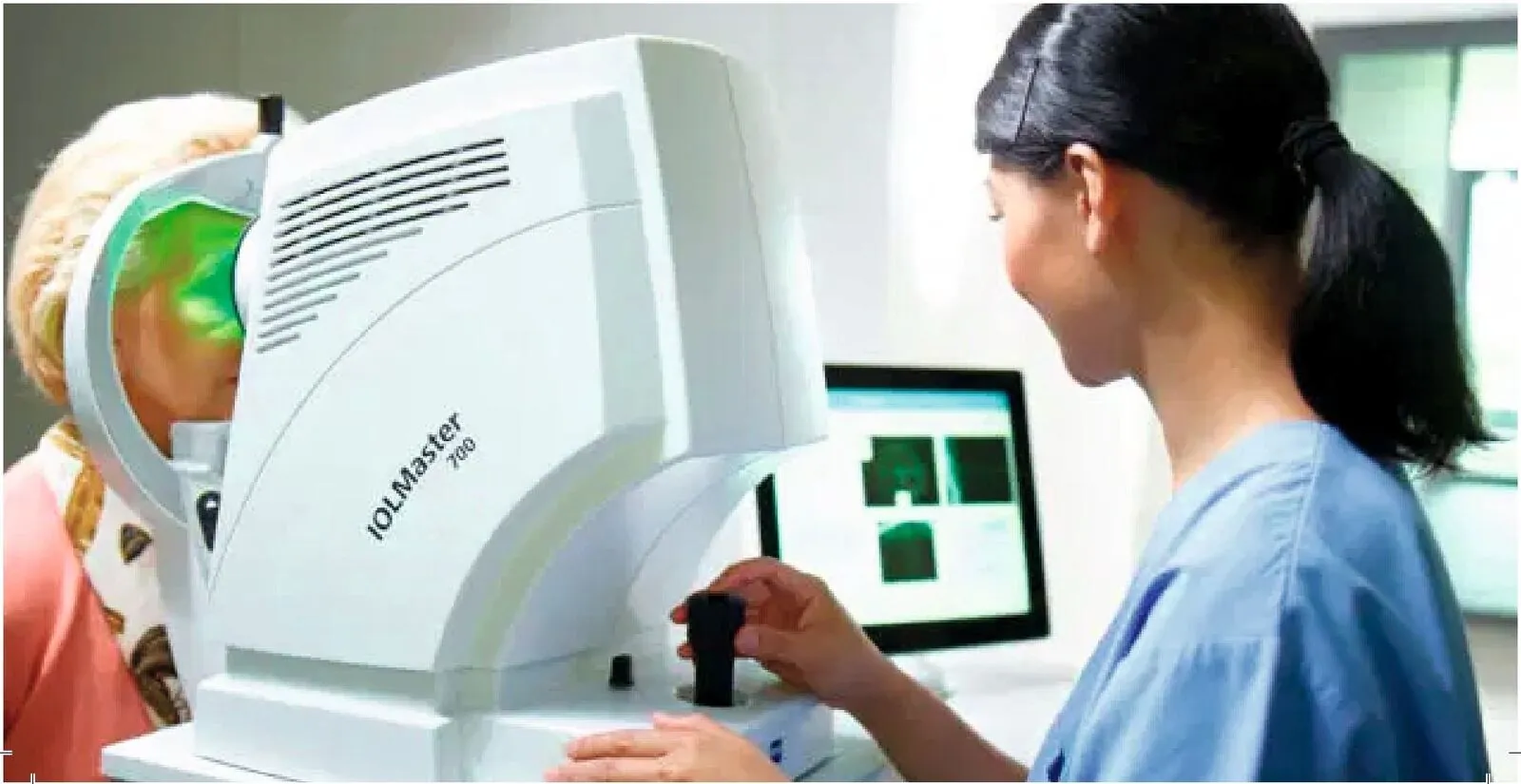
Biometry (IOLMaster 700): exact calculation of IOL power
Macular OCT: exclude retinal pathology
Topography and pupillometry: predicts optical comfort
Endothelial cell count: to assess corneal health. Endothelial cells pump fluid out of the cornea to keep it clear. Because the energy used in cataract surgery can stress these cells, the ophthalmologist verifies in advance that there are enough cells to minimise the risk of a cloudy cornea after the procedure.
Course of the procedure
The technique is identical to a regular cataract operation: as day surgery, under drop anaesthesia, through a 2 mm micro-incision. The procedure takes 10-15 minutes per eye. Both eyes are usually operated 1-2 weeks apart, allowing the brain to adapt to the new vision.
What can you expect?
The day after the procedure you already see a significant improvement.
The brain needs 4-12 weeks to adapt to multifocal vision. Light disturbance (halos, glare) during night driving occurs and strongly fades over time.
80-85% of patients with a trifocal IOL are fully spectacle-independent.
Cost & reimbursement
The cataract operation and the standard monofocal IOL are covered by health insurance. For a premium toric, EDOF or trifocal IOL a personal surcharge applies, depending on the chosen model and the hospital. You receive a detailed cost overview during your pre-operative consultation. Full cost overview →
IOLMaster 700
Precise IOL calculation
We calculate your IOL to the hundredth of a millimetre with the Zeiss IOLMaster 700, the current gold standard in cataract biometry. Combined with OCT and topography, Dr Pinxten chooses the optimal IOL together with you.
Wear contact lenses? Remove them 2 weeks before the measurements (3 weeks for toric, 4 weeks for rigid lenses).
Schedule a pre-operative work-up for premium IOLs. Based on your measurements and lifestyle, Dr Pinxten discusses which IOL model gives you the best result.